español
 English
 français
 Deutsch
 italiano
 русский
 português
 العربية
 Nederlands
 한국의
한국의 Romania
 Bulgaria
 Melayu

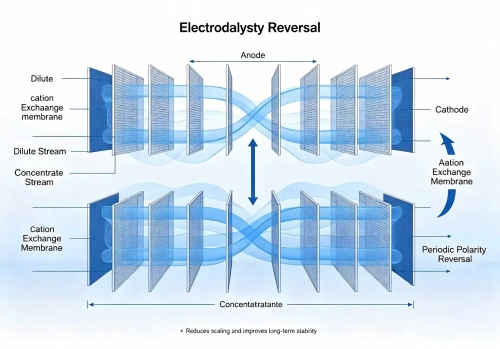
En la desalinización industrial y el tratamiento de aguas residuales de alta salinidad, muchos proyectos no se centran realmente en "si la desalinización es posible", sino en si el equipo puede funcionar de forma estable a largo plazo. La electrodiálisis tradicional utiliza un campo eléctrico de corriente continua para impulsar los cationes y aniones del agua a través de membranas de intercambio iónico Con permeabilidad selectiva, la sal en los compartimentos diluidos se reduce continuamente mientras que en los compartimentos concentrados se acumula gradualmente. La inversión de la electrodiálisis (EDR) añade, sobre esta base, una inversión periódica de la polaridad de los electrodos y un cambio de la trayectoria del flujo: tras un periodo de funcionamiento, se intercambian los roles de ánodo y cátodo, y las funciones de los compartimentos concentrado y diluido originales se invierten en consecuencia, lo que dificulta la permanencia de los depósitos que tienden a formarse en las superficies de la membrana. No se trata de un proceso de membrana completamente diferente, sino de una solución de ingeniería que refuerza la estabilidad operativa a largo plazo de la electrodiálisis, especialmente adecuada para escenarios con fluctuaciones significativas en la calidad del agua bruta, alto riesgo de incrustaciones o necesidad de una alta recuperación.
El valor fundamental de la EDR reside en la interrupción periódica de la polarización de concentración, la incrustación y la obstrucción de las superficies de las membranas mediante la inversión de polaridad. Durante el funcionamiento continuo con corriente continua, ciertos iones se acumulan cerca de las superficies de las membranas, y las elevadas concentraciones locales pueden inducir la formación de incrustaciones inorgánicas como carbonatos y sulfatos; la materia orgánica y los coloides también pueden adherirse gradualmente. Al invertir periódicamente la polaridad, cambia la dirección de la migración iónica, y las áreas previamente propensas al enriquecimiento se convierten en zonas relativamente diluidas, reduciendo así la posibilidad de que los depósitos sigan creciendo. Por lo tanto, un sistema EDR de alta calidad no es solo aquel que puede invertir la polaridad; también requiere un control de potencia estable, una coordinación fiable de las válvulas, un diseño uniforme del canal de flujo, conjuntos de membranas adecuados a la calidad del agua y un pretratamiento apropiado. Si el agua bruta contiene altos niveles de sólidos en suspensión, dureza, hierro, manganeso, materia orgánica o sílice, sigue siendo necesario un pretratamiento específico, y la función de inversión de polaridad no debe entenderse como un sustituto de todos los controles de entrada.
Desde la perspectiva de la estructura del equipo, los componentes clave de un tratamiento de agua por electrodiálisis El sistema incluye pilas de membranas, electrodos, fuente de alimentación, bombas de circulación, grupos de válvulas, instrumentación y sistemas de control. Entre ellos, las membranas de electrodiálisis y los espaciadores determinan conjuntamente las rutas de migración de iones y las condiciones hidráulicas. En la práctica de la ingeniería, el término funcional más utilizado es membranas de intercambio iónico, que incluyen membranas de intercambio catiónico y membranas de intercambio aniónico; la selección del material de la membrana debe considerar exhaustivamente la resistencia a ácidos y álcalis, la permselectividad, la resistencia eléctrica, la resistencia mecánica y la resistencia a la incrustación. Para los clientes, la selección no debe centrarse únicamente en la "capacidad de tratamiento" o la apariencia del equipo; se debe prestar más atención a los sólidos disueltos totales (TDS) de alimentación, la composición de iones principales, la conductividad del agua del producto objetivo, la tasa de recuperación, la temperatura, el pH, la dureza, la DQO y el factor de concentración admisible. Por ejemplo, para la misma agua de alta salinidad, el agua dominada por NaCl tiene un riesgo de incrustación y una estrategia operativa significativamente diferentes en comparación con el agua que contiene altos niveles de Ca²⁺, Mg²⁺ y SO₄²⁻. Una solución verdaderamente razonable generalmente requiere primero un análisis de la calidad del agua, seguido de la determinación del tipo de membrana, el número de etapas, la velocidad del flujo, la densidad de corriente y el intervalo de inversión de polaridad.
En la práctica, la EDR se utiliza comúnmente en la desalinización de agua salobre, la reducción de sal en aguas de circulación industriales, la concentración y reutilización de algunas aguas residuales de alta salinidad y el ajuste iónico de líquidos de procesos alimentarios y químicos. No se trata simplemente de "sustituir una por otra" en comparación con la ósmosis inversa: la ósmosis inversa se basa en la presión para impulsar las moléculas de agua a través de una membrana, mientras que la EDR utiliza principalmente un campo eléctrico para migrar iones; ambas difieren en la sensibilidad a la salinidad, la separación objetivo, la tasa de recuperación, el pretratamiento y el consumo de energía. Cuando un proyecto se centra en la desalinización selectiva, una mayor recuperación o la reducción del riesgo de incrustaciones a largo plazo en las superficies de las membranas, la EDR resulta claramente atractiva desde el punto de vista de la ingeniería. Para agua de producto con muy baja concentración de sal o proyectos que también requieren el rechazo de grandes cantidades de contaminantes no iónicos, puede ser necesario combinarla con ósmosis inversa, filtración u otros procesos. Electrodiálisis de membrana bipolar Pertenece a otra ruta técnica: utiliza membranas bipolares para separar el agua en H⁺ y OH⁻ bajo un campo eléctrico, lo que la hace más adecuada para la producción de ácidos/bases, la conversión de sales y la recuperación de recursos, y no debe confundirse con la EDR.
Para las empresas que evalúan soluciones de electrodiálisis, lo más importante no es decidirse primero por un modelo de equipo estándar en particular, sino aclarar “qué se debe eliminar del agua, qué se debe retener, qué calidad final del agua se debe lograr y qué costos operativos son aceptables”. Rubri, una marca de Hefei Sinopower Technologies Co., Ltd., ofrece soluciones de tratamiento de agua que abarcan electrodiálisis, electrodiálisis inversa y tecnologías de separación por membrana relacionadas. Durante las discusiones del proyecto, la configuración del conjunto de membranas, el pretratamiento, la lógica de inversión y las estrategias de control se pueden adaptar según el análisis del agua cruda, la capacidad de diseño, la recuperación objetivo y las especificaciones del agua del producto. Más información técnica y de productos está disponible en hfsinopower.comPara aguas industriales complejas, se recomienda realizar un análisis iónico completo y conocer las condiciones límite de funcionamiento reales antes de la selección formal del equipo, en lugar de juzgar si el equipo es adecuado basándose únicamente en los sólidos disueltos totales (TDS) como único indicador.
1. ¿Puede EDR impedir por completo la escalabilidad?
No. La tecnología EDR puede reducir significativamente la tendencia a la incrustación y el ensuciamiento continuos en las superficies de las membranas, pero no es una tecnología que no requiera pretratamiento. Si el agua cruda contiene una dureza excesiva, sulfato, sílice, hierro, manganeso, sólidos en suspensión o materia orgánica, aún pueden producirse incrustaciones, obstrucciones o ensuciamiento de la membrana. En ingeniería, el ablandamiento, la filtración, la dosificación química u otros pretratamientos deben diseñarse de acuerdo con los índices de saturación, la composición del agua y el factor de concentración, y el estado del sistema debe evaluarse mediante cambios en la presión diferencial de operación, el voltaje, la corriente y la conductividad.
2. ¿Mis aguas residuales de alta salinidad son aptas para el equipo EDR?
Es necesario analizar la calidad del agua en su totalidad, más allá de la salinidad. Se recomienda proporcionar al menos los principales cationes y aniones, TDS, conductividad, dureza, DQO, SS, pH, temperatura, capacidad de tratamiento, especificaciones del agua del producto objetivo y tasa de recuperación objetivo. Si las aguas residuales contienen grandes cantidades de materia orgánica no iónica, aceites o altas concentraciones de sólidos en suspensión, generalmente se requiere un pretratamiento. Para proyectos que requieren eliminación selectiva de iones, mayor recuperación o concentración de sal, la EDR suele tener un alto valor de evaluación.
3. ¿Cómo debo elegir entre EDR y ósmosis inversa?
Las fuerzas impulsoras y las ventajas de ambos procesos son diferentes. La ósmosis inversa (OI) utiliza la diferencia de presión como fuerza impulsora y es eficaz para eliminar sales disueltas y muchos tipos de contaminantes; la electrodiálisis (EDR) utiliza un campo eléctrico para impulsar la migración de iones, separa las sustancias iónicas de forma más directa y puede reducir la tendencia a la incrustación en las superficies de la membrana mediante la inversión de polaridad. La selección real debe comparar la salinidad de la alimentación, la composición iónica, la calidad del agua objetivo, la tasa de recuperación, el consumo de energía, el método de eliminación del concentrado y las condiciones de mantenimiento. En algunos proyectos, una combinación de OI y EDR es más conveniente.
4. ¿Con qué frecuencia es necesario reemplazar las membranas de electrodiálisis?
No existe un intervalo de reemplazo fijo. La vida útil real de las membranas de electrodiálisis se ve afectada por la calidad del agua cruda, la eficacia del pretratamiento, la densidad de corriente de operación, la temperatura, el pH, la frecuencia de limpieza, el ensamblaje mecánico y el grado de incrustación y ensuciamiento. En lugar de centrarse simplemente en «cuántos años antes del reemplazo», un enfoque más profesional consiste en monitorear continuamente la resistencia del conjunto de membranas, el consumo de energía por unidad de agua producida, la tasa de eliminación de sales, la caída de presión y la tasa de recuperación de la limpieza. Cuando el rendimiento continúa disminuyendo y no se puede recuperar después de la limpieza, se debe evaluar el reemplazo parcial o total.



 IPv6 RED SOPORTADA